
The Hole You Can’t See: What Jawbone Cavitations (NICO) Are and Why Your Whole Body May Care
You finally got that troublesome tooth pulled — maybe a wisdom tooth, maybe a root-canaled molar that never felt right. The gum healed over, the dentist signed off, and on paper everything looks fine. Yet months or even years later, something still isn’t right: a dull ache in the jaw, facial pain that wanders, fatigue you can’t explain, or symptoms that never quite trace back to a clear cause.
For some patients, the answer is hidden in a place a routine dental X-ray rarely shows: inside the jawbone itself. In biological dentistry, this is known as a jawbone cavitation — and understanding it is one of the things that sets a holistic, biological dental practice apart from a conventional one.
A Cavitation Is Not a Cavity
First, let’s clear up the most common confusion. A cavity is decay in a tooth. A cavitation is something else entirely: an area of poorly healed, low-blood-flow, or necrotic (dead) bone inside the jaw — usually at the site of a past extraction.
Over the years, this condition has gone by several names in the dental and research literature, including:
- NICO — Neuralgia-Inducing Cavitational Osteonecrosis
- FDOJ — Fatty-Degenerative Osteonecrosis of the Jawbone
- Ischemic or aseptic osteonecrosis of the jaw
- Areas of impaired healing, as some maxillofacial radiologists describe them
The common thread is a pocket within the bone where normal healing never fully completed, leaving behind a hollow, fatty, or infected void instead of solid, healthy bone.
Why Cavitations Form
Healthy bone needs a good blood supply to heal. When that supply is disrupted, or when infected tissue is left behind after a tooth comes out, the socket may close over on the surface while never properly filling in underneath. Common contributing factors include:
- Tooth extractions — particularly wisdom teeth, where the surgery can be invasive and the body isn’t always well prepared to heal
- Incomplete debridement — when the thin, infected periodontal ligament lining the socket isn’t fully cleaned out at the time of extraction
- Old root-canal-treated teeth and chronic low-grade infection
- Dry sockets, trauma, or poor post-surgical healing
It’s worth being upfront here: the existence and significance of cavitations is debated in dentistry. Mainstream dental organizations consider true NICO uncommon and still under study, while biological dentists — and a growing body of research — propose that these silent bone lesions are more common and more clinically meaningful than they’re given credit for. We think patients deserve to hear both sides and decide with good information.
The Oral–Systemic Question
If you’ve followed our blog, you know our central theme: the mouth and the body are connected, not separate. We’ve written about how gum disease can affect your overall health and how TMJ problems ripple through the whole body. Cavitations raise the same kind of question.
Researchers such as Lechner and von Baehr have reported that these jawbone lesions can produce inflammatory signaling molecules — cytokines like RANTES/CCL5, TNF-α, IL-1β, and IL-6 — that don’t necessarily stay put. The hypothesis in biological dentistry is that this “silent inflammation” in the jaw may contribute to systemic symptoms, which is why some patients with chronic, hard-to-pin-down complaints explore a cavitation evaluation.
To be clear and responsible: this is an area of active research and debate, not settled medical fact. A cavitation evaluation is not a cure-all, and we don’t present it that way. But for the right patient, it’s a reasonable piece of the puzzle to investigate.
Symptoms People Report
Cavitations can be completely silent — many produce no obvious symptoms at all. When symptoms do appear, patients commonly describe:
- Persistent or aching jaw pain, often near an old extraction site
- Facial pain that radiates, sometimes toward the ear or temple
- TMJ-area discomfort
- A vague sense that an old extraction “never fully healed”
- In some cases, broader complaints like chronic fatigue that the patient connects to their oral health
Because these symptoms overlap with many other conditions, a cavitation is something to rule in or out carefully — not to assume.
Why Regular X-Rays Miss Them
Here’s the diagnostic catch: a standard 2-D dental X-ray often can’t reveal a cavitation. The bone change is three-dimensional and can hide within the surrounding structure, which is exactly why these areas are so often overlooked.
That’s where modern imaging changes the picture. A CBCT (cone-beam computed tomography) scan produces a detailed 3-D view of the jaw, and with the right software a trained biological dentist can measure differences in bone density — using metrics like Hounsfield units — to locate and map suspected pockets of low-density or necrotic bone that a flat X-ray would simply not show.
How a Biological Dentist Evaluates and Treats Cavitations
At Smilecreator of Alabama, we approach suspected cavitations the way we approach all of our biological dentistry: thoroughly, conservatively, and with the whole body in mind. The general process includes:
- Advanced 3-D imaging. A CBCT scan with bone-density measurement to locate and plot any suspected lesion precisely, since these areas rarely appear on conventional X-rays.
- Conservative surgical cleaning (debridement). When treatment is warranted, a small, targeted incision is made over the mapped area to remove dead or infected bone and any leftover ligament tissue — the core step in resolving the lesion.
- Disinfection with medical-grade ozone. Ozone helps destroy bacteria, viruses, and fungi, reduce inflammation, and increase oxygenation at the site.
- Gentle, precise instrumentation. Tools such as PiezoSurgery and lasers allow tissue-sparing cleaning and additional disinfection.
- Regenerative support with PRF. Platelet-Rich Fibrin, drawn from your own blood, is rich in growth factors that support natural healing and new, healthy bone formation — often combined with bone grafting.
- Whole-body healing support. Detoxification support, nutrition, and oxygen-based therapies can complement recovery, in keeping with our holistic philosophy.
There’s an added practical benefit: healthy, well-healed bone is also the foundation for successful dental implants. Addressing a compromised site first can improve the odds of long-term implant success down the road.
Should You Be Checked for a Cavitation?
Not everyone needs a cavitation work-up, and we don’t believe in manufacturing concern. But it may be worth a conversation if you have:
- Lingering pain or a “never healed right” feeling at an old extraction site (especially wisdom teeth)
- Unexplained facial or jaw pain that conventional dental exams haven’t resolved
- A history of difficult extractions, dry sockets, or old root canals — paired with chronic, hard-to-explain symptoms
- A desire for a thorough, whole-body dental evaluation before implant treatment
The honest goal is clarity: a careful exam and, when appropriate, 3-D imaging to find out what’s actually there — no more, no less.
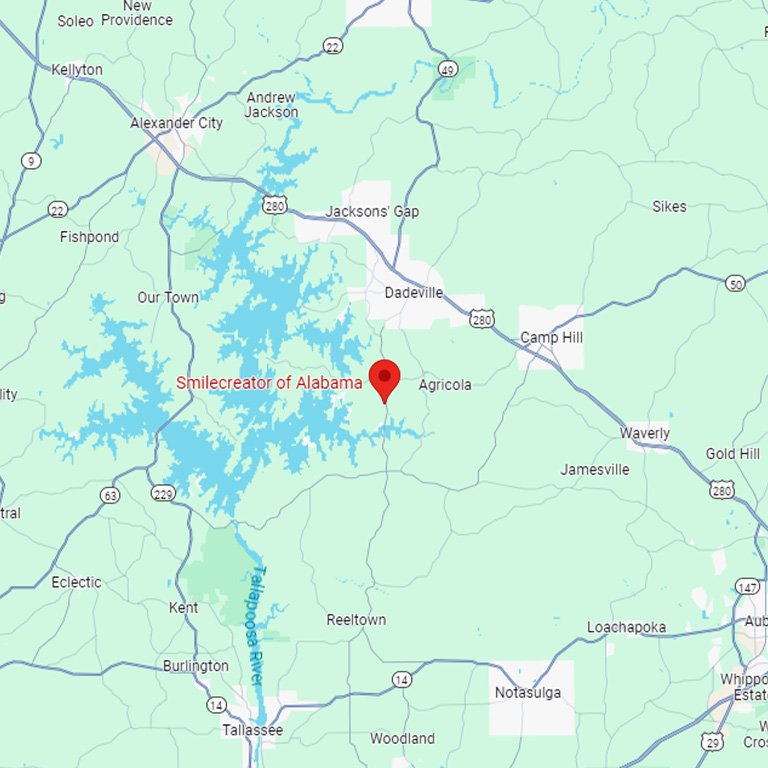
A Biological Approach Near Lake Martin
Finding a dentist who even looks for cavitations — let alone has the imaging and training to evaluate them — can be difficult. For patients across the Lake Martin region, Smilecreator of Alabama offers that biological perspective close to home. Dr. Nilo Hernandez has practiced dentistry since 1991 and built his Dadeville office around holistic, whole-body care supported by advanced digital technology and a famously gentle chairside manner.
If an old extraction or unexplained jaw discomfort has been nagging at you, you don’t have to keep guessing.
Frequently Asked Questions
What is a jawbone cavitation? It’s an area of poorly healed, low-blood-flow, or dead bone inside the jaw — usually at an old extraction site. It is different from a tooth cavity, which is decay in a tooth. It’s also referred to as NICO, FDOJ, or ischemic osteonecrosis of the jaw.
Are cavitations real? They’re recognized and treated within biological dentistry and supported by a growing body of research, but their frequency and clinical importance are still debated in mainstream dentistry. We discuss the evidence openly so you can make an informed choice.
Why didn’t my regular X-ray show a cavitation? Standard 2-D X-rays often can’t reveal these three-dimensional bone changes. A 3-D CBCT scan with bone-density analysis is far better suited to detecting them.
How are cavitations treated? When treatment is appropriate, the lesion is conservatively cleaned out (debridement), disinfected with ozone and lasers, and supported with regenerative therapies like PRF and, when needed, bone grafting to encourage healthy bone regrowth.
Where can I get evaluated for cavitations near Dadeville, AL? Smilecreator of Alabama provides biological, whole-body dental care — including cavitation evaluation and treatment — in Dadeville, convenient to the entire Lake Martin area.
Have a “mystery” jaw issue worth a closer look?
📍 Smilecreator of Alabama — 5958 AL-49 Unit C, Dadeville, AL 36853 📞 256-373-8333 (after hours: 208-646-1464) ✉️ info@smilecreator.com 🕘 Monday–Thursday, 9:00 AM – 5:00 PM
👉 Request an Appointment and ask about a biological evaluation for jawbone cavitations and whole-body dental care.
Medical disclaimer: This article is for general educational purposes and does not replace personalized advice from a licensed dentist or physician. The diagnosis and significance of jawbone cavitations (NICO) is an area of ongoing research and clinical debate. Any decision about evaluation or treatment should be made in consultation with a qualified provider after an individual examination.



Leave a Reply
Want to join the discussion?Feel free to contribute!